Updated on October 29th, 2026
If your furnace smells like burning the first time you turn it on in the fall, it is almost always dust burning off the burners and heat exchanger after months of sitting idle. That smell is normal and usually fades within an hour or so. A burning smell that lasts more than a few hours, smells electrical or like hot plastic, or shows up in the middle of the season is not normal. Turn the system off and call a technician.
Furnace Smells at a Glance
| Smell | Likely Cause | Normal or Not | What to Do |
|---|---|---|---|
| Dusty or burnt dust at first startup | Dust that settled on the burners and heat exchanger over the summer | Normal if it fades within a few hours | Open a window, let it run, and check the filter |
| Electrical, burning plastic, or hot metal | Overheating blower motor, damaged wiring, or debris in the ducts | Not normal | Turn the furnace off and call a technician |
| Burning rubber | Worn blower belt or a motor running hot | Not normal | Turn the furnace off and call a technician |
| Heating oil or smoky exhaust (oil heat) | Dirty burner, oil leak, soot, or delayed ignition | Not normal | Turn the burner off and schedule service |
| Rotten eggs or sulfur | Possible natural gas leak | Emergency | Leave the house and call from outside |
| Musty or moldy | Moisture and mold in the ducts, coil, or filter | Not urgent | Change the filter and book an inspection |
| Exhaust or chemical fumes | Venting problem or cracked heat exchanger | Not normal | Turn it off, ventilate, and call |
Burnt Dust at First Startup Is Normal
Over the summer, dust settles on the burners and heat exchanger. The first heating cycles cook it off, and the smell travels through every vent. Carrier says this burning dust smell usually lasts about 30 minutes to a few hours.
Crack a window and let the furnace run. If the smell is still strong after a few hours, or it gets stronger instead of fading, treat it as something other than dust.
A Dirty Filter Makes It Worse
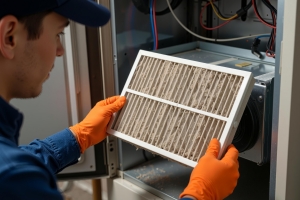
A clogged filter holds dust in the airflow and chokes the furnace, so the blower motor and heat exchanger run hotter. That can turn a short first day smell into one that keeps coming back.
Pull the filter and hold it up to a light. If you can’t see through it, replace it. Our guide on how often to change your furnace filter covers the right schedule for your system and household.
Electrical, Burning Plastic, or Hot Metal Smells
An electrical, burning plastic, or hot metal smell usually points to an overheating part. The usual suspects are a blower motor straining against a dirty filter, damaged wiring, or a failing component. Sometimes it is simpler, like a plastic toy that fell through a floor register onto a hot duct.
- Turn the furnace off at the thermostat.
- If the smell is strong, also shut off the furnace switch or its breaker.
- Check your floor registers for anything that fell in, using a flashlight.
- Leave the cabinet closed. The wiring and motor inside are a job for a technician.
If you see smoke or flames, get everyone out and call 911. Don’t restart the furnace until it has been checked.
Burning Rubber Smell
Many older furnaces use a rubber belt to drive the blower. As that belt wears, it can slip and give off a burning rubber smell. A motor running hot can smell similar, since the insulation on its windings starts to cook.
Turn the furnace off and have it looked at before it quits on the coldest night of the year. Our furnace repair and maintenance team works on both gas and oil furnaces.
Oil Heat Smells Most Guides Skip
Most guides assume a gas furnace. Plenty of older homes in Westchester and the Hudson Valley still heat with oil, through either a furnace or a boiler, and oil systems have their own warning smells.
- A strong heating oil smell in the basement or living space
- A smoky or exhaust smell that wasn’t there last season
- Black soot around the burner, the flue pipe, or your registers and radiators
- A rumble or thump when the burner starts or after it shuts down
These signs often trace back to a dirty or worn nozzle, ignition trouble, a leaking oil line, or a burner that is out of adjustment. The serious risk is delayed ignition, where unburned oil collects in the combustion chamber and then lights all at once. That puffback can blow soot through the whole house.
If your burner locks out, press the reset button once at most. Pressing it again and again pumps more oil into the chamber and raises the odds of a puffback. Turn the burner off and call for service instead. Oil boilers have the same burner and the same risks, so the same rules apply.
Rotten Egg or Sulfur Smell Means Leave Now
Natural gas has no smell of its own. Utilities add a chemical called mercaptan so a leak smells like rotten eggs. If you smell it anywhere in the house, treat it as an emergency.
- Leave the house right away and take everyone with you.
- Don’t flip switches, light anything, ring a doorbell, or use your phone inside.
- Once you are outside and away from the house, call Con Edison at 1-800-752-6633 or 911. If another utility serves your home, call its gas emergency line.
- After the utility has made the house safe, call us for emergency gas line repair.
Don’t try to find the leak or shut off the gas yourself. That is the utility’s job.
Musty or Moldy Smells
A musty smell when the heat kicks on usually means moisture is feeding mold or mildew somewhere in the system. Common spots are the air conditioning coil above the furnace, a neglected humidifier, the filter, or ductwork in a damp basement.
It isn’t an emergency, but it won’t clear up on its own. Change the filter first. If the smell stays, read our guide to mold in HVAC systems and air ducts and book an inspection.
Exhaust Fumes, Carbon Monoxide, and Cracked Heat Exchangers
Carbon monoxide is colorless and odorless, so your nose can’t warn you about it. A smell of exhaust does mean combustion gases may be getting into the house, and CO can come along with them. No smell at all doesn’t mean you’re safe.
One source of leaking combustion gases is a cracked heat exchanger. Years of heating and cooling fatigue the metal, and a furnace that overheats from a dirty filter or poor airflow cracks sooner. Lennox lists the warning signs as a CO alarm, unusual burning or metallic odors, soot, frequent short cycles, rust on the furnace or flue, and unexplained headaches or nausea in the household.
Your real protection is working CO alarms. The CPSC recommends alarms on every level of the home and outside sleeping areas, a test every month, and fresh batteries at least once a year unless the alarm has a sealed 10 year battery.
If a CO alarm sounds or anyone feels dizzy, sick, or headachy, get everyone outside and call 911. Don’t run the furnace again until a technician has inspected it.
Space Heaters Smell Too
A stored space heater often smells dusty at first, and that should fade quickly. A burning plastic smell at the cord, plug, or outlet is different. Turn the heater off and unplug it if you can do so safely.
The CPSC advises keeping space heaters at least three feet from anything that can burn and plugging them directly into a wall outlet, never an extension cord or power strip.
Normal or Shut It Off Now?
Wait it out if
- It is the first cold day and the smell is dusty
- It fades within a few hours
- It goes away after you replace a dirty filter
Shut the furnace off and call if
- You smell electrical, burning plastic, hot metal, or rubber
- A dusty smell lasts longer than a few hours or keeps returning
- You smell heating oil or exhaust, or you see soot
- The burner rumbles or thumps at startup
Leave the house now if
- You smell rotten eggs or sulfur
- A CO alarm sounds or someone has CO symptoms
- You see smoke or flames
If the furnace won’t restart once the smell is handled, our gas furnace troubleshooting guide walks through the safe checks you can do yourself.
A burning smell that won’t fade is worth a look before it becomes a no heat call in January. A. Borrelli Mechanical services gas and oil furnaces and boilers across Westchester, Putnam, and Dutchess counties. Contact us online or call (914) 809-9070 to schedule a visit.
Frequently Asked Questions
A dust smell at first startup usually fades within an hour and should be gone within a few hours of steady running. If it lasts longer, keeps returning on later cycles, or gets stronger, something other than dust is heating up. Replace the filter, and if that doesn’t help, turn the furnace off and have it inspected.
Only if you know it is first startup dust and it is already fading. An electrical, plastic, rubber, oil, or exhaust smell means the furnace should be off until it is inspected. Never sleep through a rotten egg smell or a CO alarm. Leave the house and call from outside.
Pet hair and dust that collect on the filter, the blower, or the heat exchanger can smell like burning hair once they get hot. Homes with dogs or cats see this more often. A fresh filter and a professional cleaning of the blower usually solve it. If the smell turns electrical, shut the furnace off.
Dust burn-off happens at the start of the season, so a new burning smell in midwinter points to something else. Common causes are a clogged filter, an overheating blower motor, a slipping belt, or damaged wiring. Turn the furnace off at the thermostat and call a technician instead of waiting for it to fade.