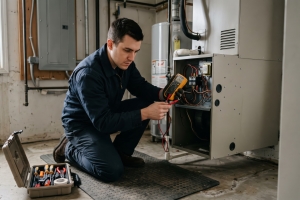
Furnaces often fail slowly over many years. You may notice a rising heating bill, weak airflow, rooms far from the furnace not quite reaching temperature, or repeated repairs.
These are all signs of a failing furnace. Homeowners who read these signals right can often get ahead of a real breakdown, and replace the furnace on their own schedule instead of calling emergency HVAC services when the house already cold.
| In this article: Most furnaces give you two or three seasons of warning before they quit for good. Here are seven signs your furnace needs to be replaced, what each one points to inside the unit, and the one that means shutting the system down tonight. |
How Furnaces Actually Fail
A furnace is a collection of parts that don’t wear out at the same rate and don’t have the same service life. Over its lifetime, the heat exchanger expands and contracts through tens of thousands of firing cycles, and eventually the metal fatigues. Blower bearings dry out, the inducer motor slows, and the control board goes through years of voltage swings.
Often, smaller and less expensive components need to be replaced periodically. But several of the larger, more expensive components reach the end of their service life within a season or two of each other, around year 15, which is why repair bills often arrive in clusters.
A technician can see the decline before you feel it. Temperature rise measured across the heat exchanger and checked against the nameplate range shows whether the unit still moves heat as built, and static pressure readings in the ducts show whether the blower is fighting the house.
Those numbers drift for seasons before rooms start to feel cold, which is why homeowners should consider working with installers who also provide maintenance service plans. ENERGY STAR suggests considering replacement once a system passes 15 years.
The Seven Signs Side by Side
Before booking an inspection, ask yourself if you’re experiencing any of these signs from your system.
| Sign | What It Usually Means | Repair or Replace? |
| Utility bills climbing year over year | Falling combustion efficiency or a tiring blower motor | Replace if past 15 years |
| Rooms heat unevenly | Weak blower, duct leakage, or an undersized system | Repair first, then reassess |
| Short cycling or constant running | Oversizing, a failing limit switch, or heat exchanger trouble | Diagnose immediately |
| Banging, rattling, or squealing | Worn bearings, loose panels, or delayed ignition | Repair unless it recurs |
| Repairs in back-to-back seasons | Several components reaching end of life together | Replace |
| Yellow burner flame or soot | Incomplete combustion and possible carbon monoxide risk | Stop use and call immediately |
| Unit is 15 to 20 years old | Normal service life is ending | Plan replacement now |
The One Sign That Is a Safety Problem
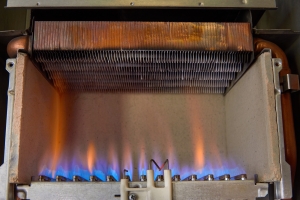
Natural gas burns with a steady blue flame. A persistent yellow or lazily flickering flame points to incomplete combustion, which the EPA notes causes higher pollutant emissions. Soot streaks around the burner compartment or vent connector, moisture on nearby windows, and a triggered carbon monoxide alarm point in the same direction.
If you see these signs, shut the system down at the service switch, open windows, and get everyone out of the building. If anyone has a headache, nausea, or dizziness, seek medical attention. Then, call for emergency service. New York’s Amanda’s Law requires carbon monoxide alarms in homes with fuel-burning appliances, with at least one on the lowest story containing a sleeping area.
When Repair Still Makes Financial Sense
The unit’s age helps determine whether repairing or replacing is the right decision. On a nine-year-old unit, a failed igniter, pressure switch, or blower capacitor is a sensible repair with years of service still ahead. For units over 15 years old, a long-standing guideline holds that a repair approaching half of the replacement cost rarely pays back.
During an inspection, while the technician has the unit’s panels off, ask what else is near the end of its life. Then ask whether the failed part is still manufactured, because discontinued parts can take extra time to source.
Efficiency is also a consideration. The Department of Energy finalized a standard requiring residential furnaces built after December 2028 to reach at least 95% AFUE (annual fuel utilization efficiency), and an ENERGY STAR-certified furnace runs about 15% more efficiently than a conventional model. Going from a 1990s unit to a modern condensing furnace changes what the house costs to heat every month.
Replacing Before Winter Forces the Choice
Westchester’s housing stock is older than most of the country’s, with a median construction year before 1960. Many homes have changed over the years, and furnace updates haven’t always kept up with increased demand as rooms were added or attics were converted into living space.
When replacing a furnace, the Air Conditioning Contractors of America recommends starting with a room-by-room load calculation rather than going by the capacity stamped on the old nameplate.
Permit requirements vary by municipality, so confirm what your town requires. Incentives through NYSERDA and local utility programs change year to year, so check current offerings before signing.
Replacing in September rather than January buys real scheduling, actual equipment choices, and time to look at financing without a cold house deciding for you.
Talk It Through With Someone Local
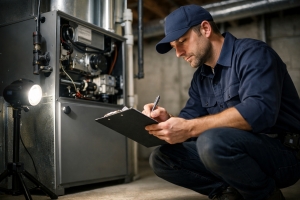
If last winter your furnace showed signs it was beginning to struggle, consider having it checked before you need it this season. Having your unit inspected early gives you time to have it repaired or replaced before you need to rely on it.
A. Borrelli Mechanical has been working in Westchester homes since 1981, and our technicians will tell you honestly whether your system shows signs it’s nearing the end of its service life and if repair or replacement is warranted. Call us at (914) 809-9070 or contact us online to schedule a furnace assessment today. The good guys are on the way.