Many owners of older homes in Westchester County, New York, have developed the same habit. Before filling a glass with water, they run the tap and wait a few seconds for the water to clear. They aren’t too concerned because they see it happening in other homes, their water pressure is holding up, and their last pipe repair was a relatively minor fix.
So none of this feels like an emergency. But in many Westchester homes built before the 1960s, that small habit is worth a second look. It’s often the first sign a home needs pipe replacement, and it could signal more serious problems to come.
Why Older Westchester Homes Show Symptoms First
Many of Westchester’s homes were built before the 1960s, when galvanized steel supply lines were the standard. But galvanized steel has longevity issues that homeowners must contend with.
For example, if a homeowner fixed a plumbing issue by connecting a more modern, copper fitting to a galvanized steel pipe, then (through a process called galvanic corrosion) the steel will corrode relatively quickly. This is common near water heaters and other areas where homeowners frequently do repairs on their own.
Soft or acidic water can also dissolve the zinc that protects the pipe’s interior, leaving the underlying steel exposed to oxygen-rich water that causes the steel to rust. This can create problems, including deposits forming on the pipe’s inner walls and the pipe corroding from the inside out, where the damage can’t be seen.
Homes built before 1986 also used plumbing joints and fittings soldered with high-lead solder. It was standard practice at the time, but it doesn’t meet modern standards.
The plumbing issues these problems cause tend to go unnoticed because they show up gradually. A little less pressure this year than last. Water that used to run clear is now taking a few seconds for the air bubbles to escape.
None of it registers as a problem because nothing changed overnight. Homeowners adapt without realizing it.
Symptoms Worth Taking Seriously
When a home needs pipe replacement, it will show certain symptoms. If these show up at only one or two fixtures, you may only need to replace the lines to those fixtures. But if these issues are happening everywhere, your dwelling may need a whole-house repiping.
The following table lists some signs that plumbers look for. No single symptom tells you exactly what’s happening inside the wall. But they can tell you it’s time to have a plumber look at what you can’t see.
| Symptom | Common Cause | What It Suggests |
| Brown or rusty water | Corroding galvanized steel | Supply lines nearing the end of useful life |
| Pressure drops at one tap | Scale narrowing the pipe | Buildup inside an aging line |
| Repeat pinhole leaks | Corrosion along a run | The material itself is failing |
| Green crust at joints | Slow seepage at fittings | Leaks forming before they show |
| Water clears after running | Sediment sitting in the line | Standing corrosion inside the pipe |
What the Pipe Material Tells You
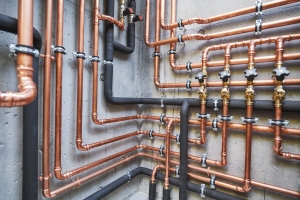
Different pipe materials fail in different ways and under different water chemistries. Knowing what’s in the walls changes what the symptoms mean.
Because galvanized steel corrodes from the inside, the pipe’s interior diameter narrows over time, often long before a leak shows up. That’s why pressure loss is usually the first sign of an issue with galvanized steel.
Copper behaves differently. While it typically outlasts galvanized steel by a wide margin, it will also corrode. When a copper run starts to fail, you might find pinhole leaks in the same section of pipe again and again. A single pinhole in copper isn’t necessarily a sign of anything bigger. A second or third leak in the same area often means the whole run is compromised.
Polybutylene is another material older homes should know about. It was widely used in homes from the late 1970s into the early 1990s, when reliability problems pushed it out of use. If your home, or major additions or repairs to your home, fall in that timeframe, let your plumber know. It may change how they assess any problems you report.
The Symptom You Cannot See
Many plumbing issues become obvious through changes in water quality or how it behaves at the tap. But lead is different.
Lead has no color, taste, or smell. Water can be contaminated with it with no outward sign, and according to the EPA, the only way to know if your water contains lead is to test for it.
The EPA also notes that lead is especially dangerous to children under six because as their bodies grow, they can absorb more of the toxic metal. Symptoms in children can include anemia, hyperactivity, loss of focus, and developmental delays. In adults, exposure to lead can show up as decreased kidney function, blood pressure or heart problems, and difficulty concentrating.
Many people assume that boiling lead removes lead from water and makes it safe to drink. But this is a misconception. Boiling water does not remove lead.
What an Evaluation Actually Involves
A plumbing evaluation for aging pipes involves a technician checking the material of the supply lines where they’re accessible. They examine joints and fittings for the slow seepage that shows up as crust or discoloration before it becomes a drip. They test water pressure at multiple fixtures, not just the ones that are acting up. And they look for visible corrosion where old and newer sections of pipe meet.
What comes out of that evaluation will be a water line repair recommendation that addresses your needs. Sometimes that means replacing a single failed line while the rest of the system still has useful life left. But sometimes, a whole house repiping is necessary. The evaluation will clearly explain your situation before you commit to a scope of work.
When Repair Stops Being Worth It
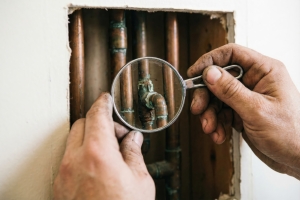
Fixing a pipe once is maintenance. Fixing the same pipe twice is a warning. A second repair on the same run, especially within a year or two, often suggests the material itself is the problem and that the next failure is a matter of when, not if.
At that point, it’s worth doing the math. How many emergency repairs on a failing run, each with its own service call and its own opening and closing of a wall, will total more than a single planned replacement scheduled at a time that works for your household?
Trying a repair once or twice isn’t wrong. It’s the pattern that tells you when to stop treating the symptom and address the pipe itself.
Get a Straight Answer About Your Pipes
If you’re one of the many homeowners in Westchester County, New York, who’s slowly grown used to weakening pressure and cloudy water coming from your tap, a straightforward evaluation will get you a real answer.
Contact A. Borrelli Mechanical for a plumbing evaluation. We’ve been looking after Westchester’s plumbing since 1981, and our licensed technicians can tell you whether you’re looking at a bad connection, a bad section, or a system that’s reached the end of its run. The good guys are on the way, and they’ll give you an honest assessment of what your pipes actually need.