
A properly selected boiler delivers consistent comfort, predictable heating costs, and a system that matches your home’s requirements without wasting energy.
Replacing an older unit may seem straightforward, but choosing the right residential boiler affects both long-term comfort and operating expenses.
| In This Article: Learn the clear warning signs that call for immediate boiler repair, which issues can be safely monitored for a short time, and practical guidance to help you protect your home, comfort, and heating system. |
How Boiler Selection Influences Heating Performance
A boiler that does not match the home’s heating demand often leads to uneven temperatures and higher utility bills.
Oversized systems often short-cycle, accelerating component wear while burning extra fuel during inefficient, brief run periods. Undersized equipment can struggle during colder weather, leaving rooms slow to warm or inconsistent from floor to floor.
Choosing the right boiler for the home size and use supports steadier operation, quieter performance, and results in a longer service life.
Experience in the field shows that systems closely matched to the home’s actual heat loss run more smoothly throughout the season. An expert evaluation helps better align boiler output with real-world conditions inside the house.
Determining The Right Boiler Size For Your Home
Boiler sizing depends on far more than square footage alone. Insulation quality, window performance, ceiling height, and local climate all influence how much heat a home actually needs. Two houses with the same layout can require very different boiler capacities if one is drafty or poorly insulated.
Oversizing often happens when a new unit is chosen based on the rating of the old boiler, even though older systems were frequently oversized from the start. Undersizing also creates problems, especially during cold snaps when the system runs constantly without fully recovering indoor temperatures.
Professional recommendations rely on a heat-load calculation, commonly based on industry methods such as Manual J. The process measures how quickly a home loses heat under design conditions, then matches the boiler output to that load for balanced comfort and efficiency.
Understanding Boiler Types & Which Homes They Fit Best
Different boiler designs handle heating and hot water in distinct ways. The right choice depends on a combination of household size, mechanical space, and how many fixtures may draw hot water at the same time.
Matching the boiler to the home’s needs often means balancing space-saving design with overall hot water performance.
Combi Boilers
Combi boilers simplify system design by delivering heating and hot water from one streamlined unit.
These systems work well in smaller homes or properties with limited space in their respective mechanical rooms. Hot water is produced only when needed, removing the need for a dedicated storage tank.
Homes with moderate hot water use tend to see the best results. Multiple showers running at once can strain capacity, so professional sizing focuses as much on hot water flow as on heating output.
System Boilers
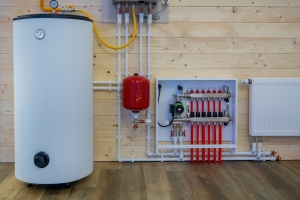
System boilers pair the heating unit with a separate hot water cylinder, which supports higher simultaneous hot water demand, making it suitable for medium- to larger-sized homes. Hot water stored in a tank allows multiple fixtures to run without a noticeable drop in temperature.
Homes that already have a cylinder often find this option practical during an upgrade. The added storage does require more space and introduces some standby heat loss.
Conventional Boilers
Conventional boilers, sometimes called heat-only systems, work with both a hot water cylinder and additional storage tanks in certain layouts. These systems fit larger homes or properties with multiple bathrooms and lower incoming water pressure.
Existing tank setups often make conventional boilers a straightforward replacement. The tradeoff is the space required for tanks and slightly lower pressure at fixtures, depending on the configuration.
Fuel Type Considerations
The choice of fuel can shape your installation requirements and influence operating expenses and long-term planning:
- Natural gas boilers remain popular where service is available due to convenience and a wide range of efficient models.
- Oil boilers continue to serve many older hydronic homes, especially in areas without gas lines.
- Propane offers flexibility in similar situations but requires on-site storage.
Fuel availability often guides the decision. Many homeowners stick with their existing fuel source to limit conversion costs, though switching fuels is possible with proper planning.
The ultimate decision is shaped by installation complexity, specific venting demands, and how fuel pricing will affect costs over time.
Energy Efficiency & AFUE Ratings
An AFUE rating measures the percentage of fuel a boiler successfully converts into heat during normal seasonal operation.
Higher ratings indicate less wasted energy and lower long-term fuel use. Standard-efficiency boilers generally have lower upfront costs, while high-efficiency condensing models extract additional heat from exhaust gases.
High-efficiency systems often require higher initial investment, though rebates or financing programs can help offset the difference. Over time, fuel savings and improved comfort tend to narrow the cost gap.
Additional Features That Improve Performance & Convenience
Modern boilers achieve better comfort levels through refined control technology that adjusts output more accurately.
Outdoor reset technology moderates water temperature to match weather changes, preventing frequent cycling when heat demand drops. With zoning systems, different parts of the house can be heated separately to better suit varying comfort needs.
Smart thermostats, built-in diagnostics, and variable-speed pumps make systems easier to manage and service. Long-term value often comes from how these features shape performance across the entire heating season, rather than the initial purchase price alone.
Professional Assessment & Installation Recommendations

Technicians evaluate far more than the boiler itself before making a recommendation.
Home layout, radiator condition, venting options, and hot water demand all influence system performance. Water temperature requirements of existing emitters play a large role in deciding between standard and high-efficiency models.
Proper installation supports safe operation and real-world efficiency. Attention to venting, combustion air, control setup, and commissioning details shapes how the system performs after installation.
A. Borrelli Mechanical guides homeowners through comparing options based on budget, performance, and long-term operating costs.
Find The Right Boiler For Your Home With A. Borrelli Mechanical
At A. Borrelli Mechanical, choosing the right boiler starts with understanding how your home heats, how your family uses hot water, and what will make the system dependable year after year.
After more than four decades serving Westchester County, we have seen firsthand how proper sizing, realistic efficiency expectations, and thoughtful system selection lead to quieter operation, steadier temperatures, and fewer surprises during the heating season.
Homeowners searching for the best boiler for their home size benefit from clear guidance rooted in experience, not guesswork. If you are ready to move forward and want confidence in how to choose a boiler, schedule a consultation with A. Borrelli Mechanical today.